Business value
Owned by the Sponsor, Product Manager and Global Revenue Architect.
Focuses on ROI and strategic fit.

OUR METHODOLOGY
The Osol AI Methodology tames the risk of probabilistic AI delivery and turns it into predictable, enterprise-grade value. It is built on ISO/IEC 27001-compliant engineering standards and ANSI/ISA-88 automation principles.
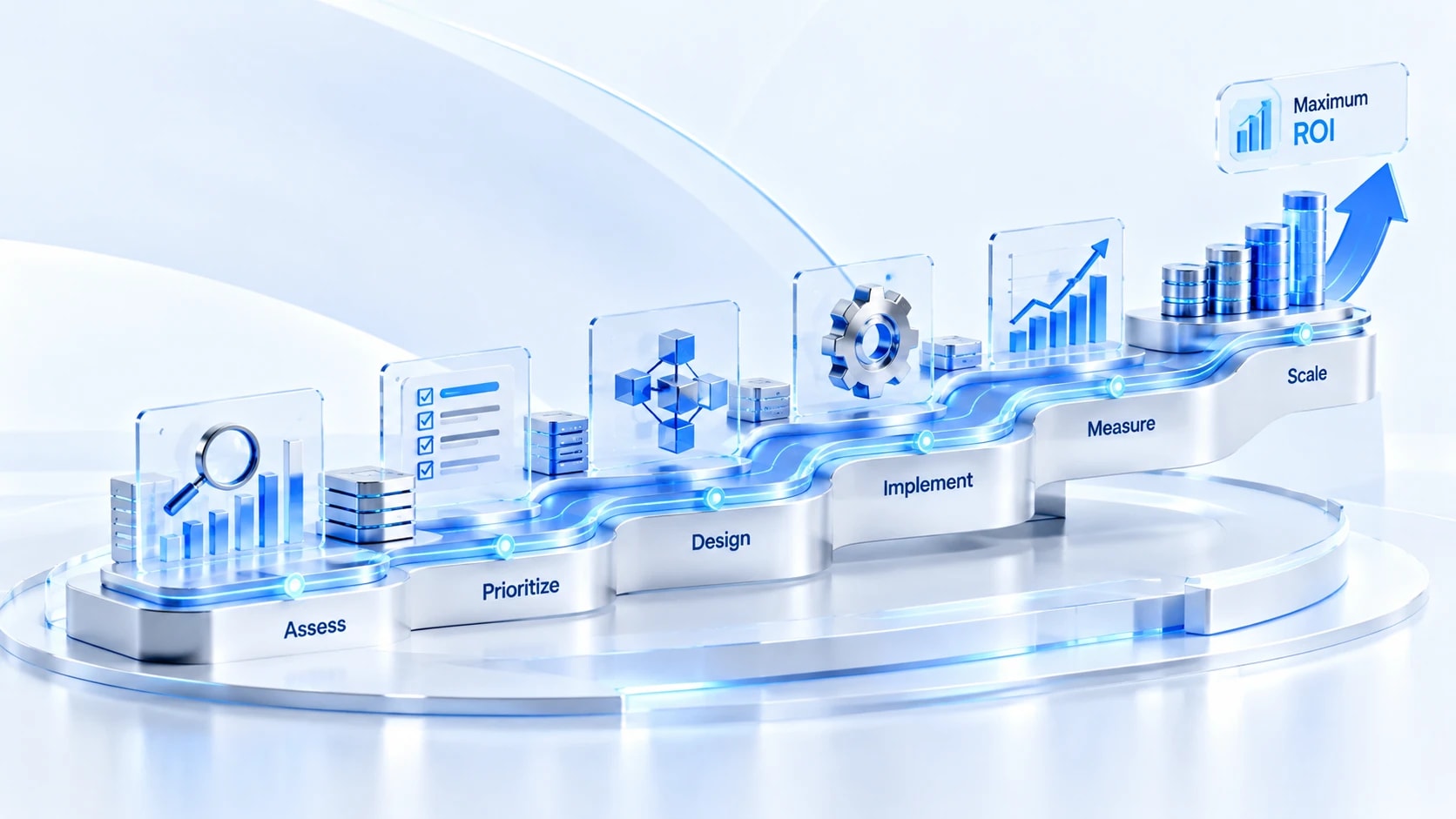
Every AI project moves through four phases, and each phase ends at a governance gate. A risk-based escalation protocol governs every gate transition, so no algorithmic risk proceeds downstream unchecked.
We prioritize measurable business impact and user needs above algorithmic novelty, with a relentless focus on speed to value.
We run scientific test-and-learn cycles. Execution is governed strictly by live data, telemetry and continuous stakeholder feedback.
Oversight is risk-proportional. Lightweight protocols scale up only when complexity and material risk demand it.
The methodology is mapped directly to the 2026 PMI Standard for AI in Portfolio, Program, and Project Management.
Outcome Integrity oversight, bias testing and human-in-the-loop (HITL) policies are embedded throughout.
Gate 1 regulatory classification checks are natively mapped to frameworks like the EU AI Act and sectoral privacy laws.
Every initiative is placed on a matrix that weighs expected value against implementation difficulty, and the matrix decides how it moves forward. Gate 0 and Gate 1 ensure every project has a clear problem statement, a verified data landscape and a projected ROI before the initial commitment is made.
Development runs in agile sprints covering data preparation, model training and API integration. Before anything is released, it must pass three compliance checks:
Key insight: The sprint determines how we build. The compliance box determines whether it is safe to release.
Gate 2 unlocks only when a model scores at least 80% across all four axes of our 4-D Quality Framework:
Usability, relevance and a positive user experience.
Precision and recall thresholds, and overall statistical stability.
Completeness, integrity and strict schema validity.
Deployability, live monitoring hooks and executed runbooks.
A 99% accurate model with terrible data reliability or no monitoring hooks will fail the 4-D framework, and deployment will be strictly blocked.
Owned by the Sponsor, Product Manager and Global Revenue Architect.
Focuses on ROI and strategic fit.
Owned by the Tech Lead and ML Lead.
Focuses on architecture, algorithmic viability and scalability.
Owned by Outcome Integrity and Security/Privacy.
Focuses on ethics, bias and regulatory readiness.
The Go/No-Go decision requires recorded sign-off from all three pillars, so no single discipline can force a flawed model into production.
Once a model is live, the incident response loop keeps it reliable. It is triggered when model drift hits the 2%/5% bands or a data schema fails. Automated telemetry then raises an alert, a human-in-the-loop SLA review responds, retraining runs as a governed workflow, and the update deploys seamlessly to production.
Benefit-realization check: Operational reviews compare the value realized in production against the initial Gate 0 ROI projection, which keeps the business continuously aligned.
No dataset enters development without a named steward and a complete datasheet. Data enters the pipeline, and a named human owner is assigned full accountability for it. A datasheet is attached that details provenance, consent basis, limitations and schema validity. Only then does governed data flow into the model and on to live deployment. A production lineage trace links every prediction back to its source.
The Outcome Integrity mandate: The Outcome Integrity (OI) role holds the unilateral power to veto any release solely on ethical or societal risk grounds.
The original cost baseline is frozen at Gate 1. The current baseline is the original plus all approved change requests.
Our entire methodology is parameterized. A Sync Agent ingests methodology updates and enforces compliance, live earned-value management and automated gate scheduling natively in code. Its features include a computed balanced scorecard module, a digital tri-party approval button and automated threshold alerts.

Partner with Osol to engineer trust.